
The Systems Underneath: Patrick Breen on the B-52H, the Backstage of Wealth Management, and Why the Infrastructure Always Drives the Performance
- Camille D. Ford | Founder & Editor-in-Chief
- Mar 18
- 10 min read

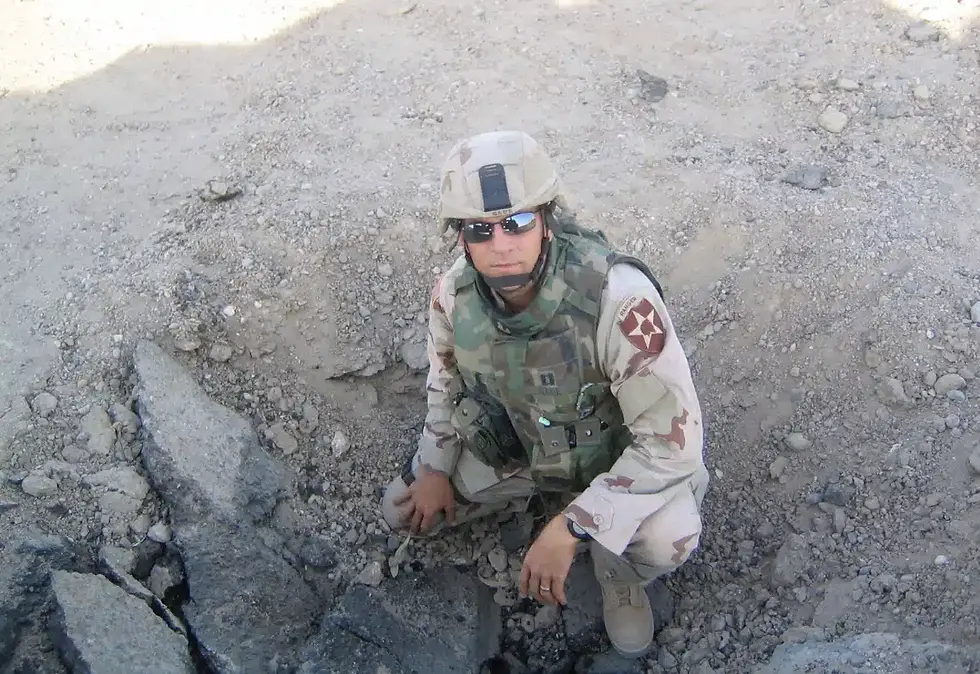
Patrick Breen grew up the youngest of four in Bayonne, New Jersey, a blue-collar city close to New York, in a house his mother had grown up in. His father was a Navy Seabee who served in Vietnam and rarely spoke about it. His mother cared for strangers and reinvented herself across industries without ever being asked to make it look easy. By the time Breen was 12, he was working. By the time he was 17, he was sitting across from an Air Force recruiter he had walked in to support a friend. He spent four years at Barksdale Air Force Base as an electrical and environmental systems journeyman on a B-52H nuclear bomber, diagnosing complex failures in minutes and keeping pilots alive inside a machine the size of a city block. He left in 2008 into the worst job market in a generation, found his way through a 60-day contract that became a career, and is now Senior Vice President and Advisory Platforms and Pricing Director at Truist Wealth. He runs the systems that financial advisors depend on the same way pilots depend on the aircraft underneath them.
Before the Uniform
Bayonne, New Jersey sits on a peninsula between Newark Bay and Upper New York Bay, close enough to the city to feel its pull and working-class enough to know you earn your own way out. Patrick Breen grew up there as the youngest of four children, all of them born within five years of each other, all of them raised in the house his mother had grown up in alongside their grandmother, parents packed in together the way families do when space is tight and everyone is needed.
His parents were not waiting for the Air Force to teach him anything. His mother demonstrated service before self in the most concrete way available to her: she cared for people, including strangers, and she kept reinventing herself across different industries and careers without treating either of those things as remarkable. His father worked in rough conditions and sacrificed a great deal to support four children, and those conditions were visible enough that none of the kids missed the lesson. By the time Patrick was 12, he had a job. All of them did. That was the expectation.
“After I joined, he opened up about his time.”
His father had served as a Seabee in the Navy during Vietnam, and growing up, Breen never fully understood what that meant. His father was quiet about that chapter of his life, the way many Vietnam veterans were, without the support structures that exist for veterans today. It was only after Breen joined the Air Force himself that something shifted between them. His father began to talk. The service became a bridge between two generations rather than a closed door, and the distance that silence had created began to close.
The idea of enlisting did not come from his father or from a deliberate plan. It came from a friend. At 17, Breen went with his closest friend to a recruiter’s office to offer support while the friend explored his options. He had barely left the tri-state area at that point, let alone been on a plane. He walked in expecting to wait. What he found, when the Air Force laid out what it offered, was something that felt like a direction. He walked out with a different future than the one he had arrived with.

A City Block That Flies
Arriving at Barksdale Air Force Base at 18 years old, newly assigned to a B-52H nuclear bomber, is not a soft landing. Breen will tell you plainly: it was scary. Intimidating. He felt lost in ways that training had not prepared him for, because training is rehearsal and this was the show. New city. New people. High expectations coming from every direction. The machine in front of him was the size of a city block and one of the most complex aircraft ever built. He had to learn it, and he had to learn it fast, and the gap between knowing that and feeling ready for it was considerable.
What the military also does, though, is close that gap. The people around him helped him build confidence quickly. The culture has a way of pulling people in and giving them enough to stand on. Most things have learning curves, but the Air Force pairs that with preparation and planning in ways that make the curve survivable. He found his footing. And once he found it, he did not lose it.
“My job was to make sure people stayed alive.”
Most people, when they think about a B-52H nuclear bomber, picture the pilot. Patrick Breen never had that luxury. Think of the B-52 as a flying city block, he says, and it takes a great deal to make sure the entire environment is safe and sound for the pilots inside it. His job as an electrical and environmental systems journeyman covered everything from power generation and distribution to cabin pressure, oxygen systems, critical redundancy circuits, and notification systems. Anything with power running through it. Anything with flow. The infrastructure the pilot never thinks about mid-flight because thinking about it is someone else’s job, specifically Patrick Breen’s job. That was not a mission statement. It was the actual standard, every day, on a Strategic Air Command installation where preparation was constant, everything done to prepare for what might happen, not what was happening.
Sixty Seconds
Zero margin for error does something to a person. It rewires the way you approach every problem, not just the ones on the flight line. At Barksdale, they ran what they called red balls: sixty seconds to diagnose the problem and solve it. No extensions. No second guessing. No waiting for someone else to step in.
“You slow down your thinking when others rush.”
You learn to assume that failure is possible, and then you have to design your processing and your thinking to prevent that failure. You verify what you already believe is correct. You build redundancy into your own thinking. When Breen left in 2008 at 22, he did not fully understand what he was carrying. He thought he had been following orders and procedural guides, not knowing he had been trained to diagnose complex systems, trace root causes through layers, think through interdependencies, and hold to a standard of consistency that most industries only talk about. Not really appreciative at 22, he says. But fast forward a couple of decades, and it definitely rings true.

The Through Line
“Infrastructure really drives the performance.”
From a nuclear bomber to financial advisor platforms sounds like the hardest left turn imaginable. Breen does not see it that way. A B-52 is a system with human operators relying on it. Financial advisor platforms are systems with human operators relying on them. The through line is not aviation. It is the principle underneath aviation: something bigger than you depends on the invisible work being done right, every time, without failure. He chose Embry-Riddle for his undergraduate degree because it accommodated military schedules, a way of staying connected to the world he was still inside while beginning to imagine the one beyond it. Rutgers for his MBA was more deliberate. By then, he was already working at a wealth management firm and wanted to understand strategy, financial markets, organizational behavior, and the psychology of decision-making.
He always had an affinity toward things that help people, he says. Finance is another way you can really change lives, another way to make things better through a process. It is the same instinct that drew him to the Air Force and kept him there: the pull toward something larger than yourself, something that requires your best work because someone else is depending on it.
The First Hard Landing
“Things happen for a reason, good or bad.”
Leaving the military in the summer of 2008 felt, in his own words, like the first time all over again: scared, intimidated, and lost. The financial mortgage crisis was at its peak. He had no internships. No prospects. No foothold in an industry that was contracting around everyone trying to enter it. He searched for almost a year.
What finally broke through was a referral. A friend connected him to a talent agency, and the agency placed him in a 60-day contract at a wealth management firm. That contract was extended. Then extended again. Then it became full-time employment. The path he could not have drawn in advance turned out to be the only one that was available to him, and he walked it anyway. That experience clarified two things he has not forgotten. Networks and relationships are not soft skills, they are infrastructure. And the hard chapters, the false starts, the year of silence from the market, are part of the story that makes you. They do not interrupt the arc. They are the arc.
Backstage
What surprised him most when he entered financial services was ambiguity. The Air Force was explicit. Success was defined before anyone walked in the door. Finance was different: compensation, incentives, culture, the rules of engagement far less clear than anything on the flight line. The Air Force had prepared him for accountability and structure, he says, but he had to learn the softer dimensions of influence. Navigating different personalities is very different from a linear military career path. The systems thinking never left, though. It just found a new machine to run.
The advisors are the pilots. Breen runs everything underneath them. “Pilots are not thinking about how much voltage is running through a breaker mid-flight,” he says. “In the same way, we do not want our advisors thinking about operational friction when serving clients. A lot of what we do is backstage. Those moments that matter should feel natural.” He approaches it with the same sensitivity and intentionality he applied to anything with power running through it.
Henry Ford and the Faster Horse
Transformation and maintenance are different animals, and Breen is clear-eyed about the difference. The Air Force trained him for excellence, consistency, and zero tolerance for deviation. They did not have the ability to experiment on a plane that was fifty years old. Transformation requires experimentation. That is a different kind of discipline, less about preventing failure and more about building toward something nobody has imagined yet.
He quotes Henry Ford when he talks to advisors and teammates about change: if Ford had asked people what they wanted, they would have asked for faster horses. The point is not to ask what people want. It is to understand what they are trying to accomplish and design toward those outcomes, looking outside the existing industry at emerging technologies and bringing them together in ways that serve the client of the future, not just the client of today. The financial industry in five years, ten years, he says, he does not know what it is going to look like. He knew what the B-52 was going to look like in five years. He finds he is more satisfied in the ambiguous, creative state where they are today. That comfort with not knowing the destination while trusting the process is itself a product of the Air Force, the discipline to execute without a complete picture because you were trained to handle whatever the picture turned out to be.
What Veterans Bring That Nobody Is Naming
Breen has watched the financial services industry get more intentional about veteran recruitment over the past several years. Most major firms now have dedicated veteran networks, recruiting pipelines, and development programs. He calls it a real positive shift, and he means it. But there is something he wishes the industry understood more clearly about what veterans actually bring to the work. Veterans are very comfortable with responsibility, he says. They understand consequences. They are trained to own outcomes. Accountability matters. Integrity matters. And the biggest thing, the one he hears most often when colleagues try to describe him, is that they do not panic under pressure.
He gets asked regularly how he stays so calm, so soft-spoken, even if the building is burning down. The answer goes back to military training. That calm is not a personality trait. It is a trained response to sixty-second red balls on a Strategic Air Command installation. It is muscle memory built on a platform where failure costs lives. When the stakes in a conference room feel high, Patrick Breen has a reference point that resets the scale. He has stood next to a machine the size of a city block and made sure it would not kill anyone. A difficult conversation about platform architecture is not a nuclear bomber launch exercise. He knows the difference.

The Access Problem
When Breen was in business school, wealth management was not even on his list. There is vagueness around it, he says. You do not really know what it is or how to get in. It is very relationship-driven. If you do not know someone, or you do not come from wealth, it might not feel like it is for you. He was not speaking about a category of people. He was speaking about himself.
He is specific about what he wishes someone had handed him sooner. Not a product brochure. Not a list of benefits. A conversation. Someone telling him plainly that what he had already built in himself, the accountability, the calm, the ability to hold a standard under pressure, was exactly what the field runs on. That nobody would have to give him that. That he already had it.
What He Would Tell the 22-Year-Old Airman
“Surprised, but probably also proud.”
If the airman at Barksdale could see where Patrick Breen is today, what would stop him? He thinks about it. He would be surprised, Breen says. He would probably recognize some of the mindset and the thinking, but surprised at how things have unfolded, the career path, the trajectory, the learnings and failures along the way. Surprised, but probably also proud.
“Veterans already have it.”
For veterans coming into financial services, he does not lead with the technical knowledge they will need to acquire. He leads with what they already carry, because that is the part nobody tells them and the part that actually matters most. You already have the hardest skill sets, he says. Accountability. Confidence. The ability to rise under pressure. The other stuff, learning the language, understanding the markets, building relationships, that will come. Stay humble and pay it back. As you are having success, be a sponsor, be a mentor, be someone who gives back to the community. Veterans already have it. It is just a matter of being confident and standing behind everything they have done.
Resources
Truist Wealth Management | truist.com/wealth
Wealth advisory services for individuals, families, and institutions.
SkillBridge Program | skillbridge.osd.mil
DoD program connecting transitioning service members with civilian career training opportunities before separation.
Transition Assistance Program (TAP) | tapevents.mil
Federally mandated program providing employment assistance and transition resources to separating service members.
American Corporate Partners | acp-usa.org
Nonprofit offering mentoring and career guidance for veterans transitioning into the private sector.
GI Bill Education Benefits | va.gov/education
Federal education benefit covering tuition, housing, and books for eligible veterans and dependents.
Consumer Financial Protection Bureau | consumerfinance.gov/servicemembers
Financial tools and protections specifically for service members, veterans, and military families.
Veterans Crisis Line | Dial 988, then press 1 | veteranscrisisline.net
About Patrick Breen
Patrick Breen is Senior Vice President and Advisory Platforms and Pricing Director at Truist Wealth, where he leads transformation and strategy for the wealth management division’s advisor infrastructure. He served four years at Barksdale Air Force Base as an electrical and environmental systems journeyman on B-52H nuclear bombers. He holds a degree from Embry-Riddle Aeronautical University and an MBA from Rutgers Business School. He is based in Richmond, Virginia.


Comments