
The Man Who Builds Big Things: A Navy engineer who spent nearly three decades building infrastructure in places most people never see
- Camille D. Ford | Founder & Editor-in-Chief
- Apr 8
- 14 min read

Summary
Ramé Hemstreet planned to serve four years in the Navy. He stayed for 29, building infrastructure across the Pacific, the Middle East, Europe, and the National Capital Region, where he retired as Commanding Officer of NAVFAC Washington. He then joined Kaiser Permanente, helping lead the organization to become the first large-scale healthcare system in the country to achieve carbon neutrality. Alongside his professional work, he volunteers with the Unforgotten Fund, supporting children in some of the world’s most impoverished communities. Across every role, the through-line has remained the same: follow the mission, build what matters, and serve something larger than yourself.
Brooklyn to Baton Rouge to Franklin
Ramé Hemstreet wasn’t supposed to end up where he ended up. He was born in Brooklyn, the only child of two parents who moved the family south when he was young, first to Baton Rouge, then to Franklin, Tennessee. He grew up a Yankee kid in the South during the civil rights era, which gave him, as he puts it, a very interesting childhood, culturally speaking. His parents were both from the North, and the South they were living in was not the quiet South of mythology. It was a South being remade in real time, and he was watching it.
“I spent a lifetime learning how much I don’t know and how big the world is.”
By the time he finished high school in Franklin, he was, by his own accounting, overconfident and naive. “I thought I was smarter than I was and smarter than other people,” he says. He’s spent a lifetime learning otherwise. “I spent a lifetime learning how much I don’t know and how big the world is.” He doesn’t say it with embarrassment. He says it the way someone does when the education that followed was thorough enough to make the starting point feel almost funny. He didn’t arrive at that understanding in a classroom. He arrived at it by going to places that stripped away the certainties a sheltered upbringing tends to install.
He went to Tulane on a Navy ROTC scholarship because his family wasn’t wealthy and he needed a way to go to a good school. He studied civil engineering because he was strong in math and wanted to go into a field where he could “build big things.” He made a practical decision, and it happened to be the right one. He raised his right hand for the first time at 17. He didn’t fully understand what he was choosing. He wasn’t supposed to. Nobody is, at 17.

Four Years That Became Twenty-Nine
He graduated from Tulane in 1982 and commissioned into the Navy. The plan was four years. That was the obligation, and he intended to honor it and move on. His first assignment put him in Newport, Rhode Island, as an officer in charge of construction, essentially a project manager for a Navy base. It was solid work. It didn’t hook him.
His second assignment did. The Navy sent him to Palau and Yap, two remote islands in the Western Pacific, as the resident officer in charge of construction. He was 23 years old. He was the minority in every room. His entire staff was Micronesian. He was drilling water wells and laying roads and building sewage systems on islands that, at the time, had almost no connection to the world most people lived in. These were remote places, and the work was real, and people’s lives depended on it getting done right. “You don’t meet a lot of people who’ve even heard of Palau,” he says. “I was 23 years old, and I was in charge of millions of dollars of projects.” He also found, for the first time, what it felt like to be the stranger in someone else’s home. He was learning to lead across a cultural distance he hadn’t anticipated, and he found he liked the challenge of it.
That was the hook. Not the authority. Not the title. The work, the places, the people, and the fact that the Navy trusted a 23-year-old with something real. He found it exhilarating. That was the word he used, and he meant it.
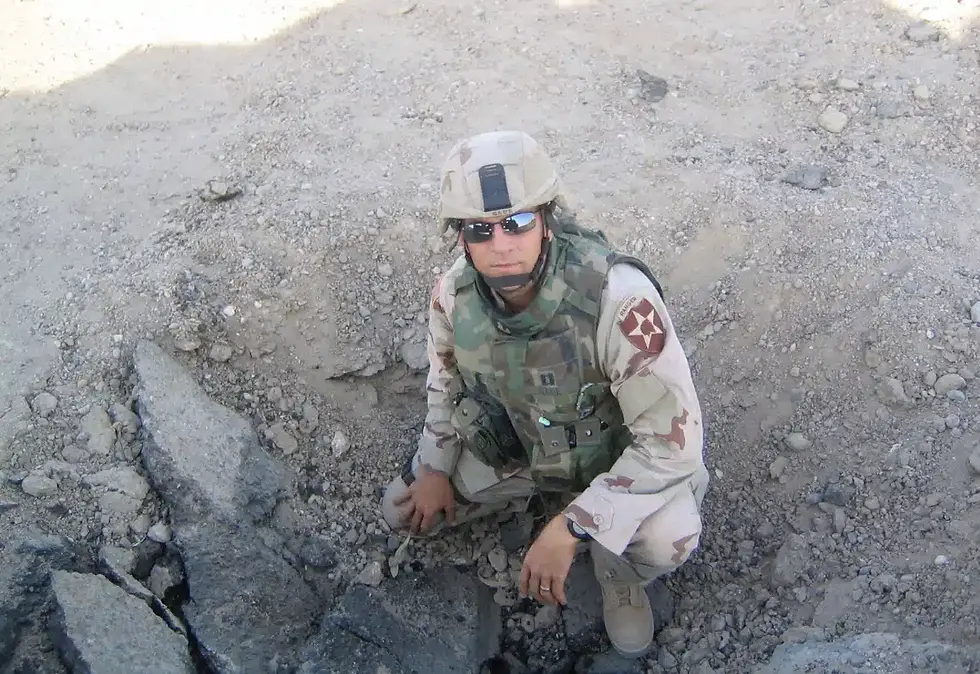
The assignments that followed took him across the United States and the world in roughly two- and three-year rotations. He served as Public Works Officer at Marine Corps Base Camp Pendleton, overseeing all design and construction at one of the country’s largest military installations and working alongside Marines he would later serve with in the field. He deployed to Saudi Arabia for Desert Storm. He deployed to Somalia for Operation Restore Hope. He was stationed in Naples for three years. He served in approximately 13 different assignments in total, each one adding a layer to his understanding of what it meant to build something that mattered.
He was stationed in Japan twice. The second tour, from 2001 to 2004, placed him in one of the most consequential infrastructure roles of his career. As Regional Engineer for Commander Naval Forces Japan, he was responsible for planning the infrastructure needs of the entire forward-deployed naval force. The work was less about pouring concrete and more about navigating relationships. His staff was largely Japanese. He negotiated land use agreements with the Japanese government. He worked through the diplomatic and logistical complexity of introducing a nuclear-powered aircraft carrier into Japan-based operations, a project that required aligning American military priorities with the sensitivities of a sovereign ally that remained, more than half a century after World War II, one of the strongest partnerships the United States had in the world. He was doing technical work embedded inside political work, and he was doing it in a country that was not his own, with people whose language and culture he was learning as he went. He found it exhilarating. That was the word he used, and it wasn’t theatrical. He meant it.
“There’s nowhere, enlisted or officer, that you’re going to get more responsibility and accountability at a young age than you do in the armed services.”
In the middle of all of it, he attended the National War College and earned a master’s in national security strategy. He was in residence in Washington, D.C., in 1998 and 1999, as the Soviet Union’s collapse was still reshaping the world order and the United States found itself the only remaining global superpower without a settled doctrine for what that meant. The program brought in speakers from across the executive and legislative branches. It asked officers to think not just about missions but about why missions existed, and what the infrastructure they spent their careers building was actually protecting. He wanted to connect the grunt work, the wells and roads and carrier berths and base maintenance contracts, to the larger architecture of how the world either holds together or doesn’t. The War College gave him a framework. He used it. What the Navy had given him first, though, was something no classroom could replicate: responsibility at a scale most people his age had never seen. “There’s nowhere, enlisted or officer, that you’re going to get more responsibility and accountability at a young age than you do in the armed services,” he says. He knew that by the time he left Palau. The War College just helped him understand why it mattered.
He retired in 2011 as Commanding Officer of NAVFAC Washington, the Navy Facilities Engineering Command responsible for every Navy and Marine Corps base in the National Capital Region. The Naval Academy at Annapolis. Quantico. Dahlgren. The Naval Observatory, whose grounds include the vice president’s official residence. Roughly a dozen installations in total, spanning everything from grass-cutting and service calls to major capital construction programs.
What made NAVFAC Washington different from every prior assignment wasn’t the scale. It was the density of accountability. Every base had its own command structure, its own leadership, its own priorities, and every one of them looked to him to deliver. A service call that goes unanswered at the Naval Observatory isn’t an abstraction. A construction delay at the Naval Academy has a human face attached to it. He had approximately 50 people he was directly accountable to on any given day. “I worked ten times harder at that job than any role I’ve ever had,” he says. There was no slow week. Those two years went by in the blink of an eye, he says, because he hardly had a chance to breathe. He makes the observation without looking for sympathy. It was the job. He did it.
He didn’t make admiral. In the Navy’s up-or-out system, a captain who doesn’t make admiral retires at 30 years. His commanding officer billet ended at 29. He could have done one more year in a staff role. He chose not to. He had finished three consecutive high-responsibility positions: operations officer for the global NAVFAC headquarters, commanding officer of another region, and then NAVFAC Washington. He was going out with something intact. “I was gonna go out with a bang,” he says. He did.
What Healthcare Didn’t Know It Needed
Kaiser Permanente hired him in 2011, straight out of command. He brought with him 29 years of building things at scale, managing complex organizations across multiple cultures, and thinking about systems in terms of what they’re actually supposed to accomplish rather than what they’ve always done. What he didn’t bring was any particular background in healthcare. He didn’t need one. What Kaiser Permanente needed was someone who knew how to build something that didn’t exist yet.
There’s a stereotype about military officers: good at taking orders, not necessarily innovative. He encountered that assumption and quietly proved it wrong. The work he was hired to do, building a path to carbon neutrality across eight regions and more than a thousand facilities, required exactly the kind of thinking that stereotype said he wouldn’t have. It required identifying what no one had tried before, finding the people inside the organization who needed to say yes, and building the case until they did.
The single largest contributor to reaching carbon neutrality was a financial instrument most people in healthcare had never heard of: a virtual power purchase agreement. In simple terms, it allows a company to enable the construction of utility-scale renewable energy by agreeing to buy the power the project eventually produces, without owning it directly. Kaiser Permanente entered into four of these agreements over the course of the decade. Together, they accounted for roughly half of what was needed to reach the goal. But getting there meant convincing people who had very good reasons to be cautious.
The chief accounting officer at the time was not immediately persuaded. Neither was the CFO. A virtual power purchase agreement was a new thing, and new things carry risk, and risk in a nonprofit healthcare system carries consequences that go beyond a quarterly earnings report. There were legitimate questions about financial exposure. There were questions about whether the structure of the deal might jeopardize their tax-exempt status. These were not unreasonable concerns, and he didn’t treat them as obstacles to be steamrolled. He treated them as problems to be solved. He built the case methodically. He brought in the right people to address the right concerns. He kept going back. Eventually, they said yes. Then he did it three more times.
In 2020, Kaiser Permanente became the first large-scale healthcare system in the country to achieve carbon neutrality.
“Protecting the health of the planet and protecting the health of people can’t be treated as separate efforts.”
The connection between environmental sustainability and human health isn’t abstract to him. Kaiser Permanente had people inside the organization who had already done the clinical work: identifying the documented health impacts of what was now being called the climate crisis. Extreme heat events. Vector-borne diseases appearing in geographies where they had never existed before. The full cascade of consequences that a changing climate was delivering to real communities in real time. He learned from those people. And once he understood what the evidence showed, the mission logic was self-evident. “Protecting the health of the planet and protecting the health of people can’t be treated as separate efforts,” he says. If Kaiser Permanente’s purpose is to improve the health of communities, and the climate crisis is one of the most significant threats to community health in the modern era, then environmental stewardship isn’t a sidebar. It’s part of the job.
Getting inside healthcare also gave him a new version of something the Navy had taught him long ago. There are far more people making an operation possible than there are people executing it. In the military, the ratio of support staff to “trigger pullers” is enormous, and that ratio exists because it has to. The same is true in healthcare. Most people only experience it as patients: a receptionist, a nurse, a doctor, a room. They don’t see the infrastructure behind the infrastructure, the supply chains and facilities and logistics networks that allow any of it to happen. COVID made that invisible machinery visible. When supply chains fractured and logistics broke down across the country, the question of who had built resilient systems and who hadn’t got answered fast. Kaiser Permanente, he says, didn’t fail. The Navy had already taught him why: wars are won or lost on logistics. So, it turned out, are pandemics.

The Unforgotten Fund
He manages a $4 billion budget. He also volunteers, on his own time, as a board member and country director for the Unforgotten Fund, a charity whose annual operating budget is approximately $100,000. Every dollar goes to the field. There are no paid staff in the United States.
The organization was founded by Amit Kapadia, a civilian environmental engineer who worked for Hemstreet at NAVFAC Washington and has, for nearly two decades, run a full-time nonprofit alongside his day job with the Navy. The Unforgotten Fund works to keep children out of trash dumps (literally, children who survive by picking through garbage in some of the most destitute communities in the world) and keep them in school instead, by providing support to those children and the mothers who are trying to hold their families together in the absence of fathers who are often gone.
Hemstreet joined the board because Kapadia asked him, and because the work was real. He is the country director for Zambia. The fund also operates in India, Nepal, Bangladesh, Yemen, and Ethiopia. He has been to Zambia multiple times. He went to India with the fund. He has watched children he first met as grade schoolers, kids he knew by name, kids whose situations he understood, make it all the way to college. The fund isn’t always successful. They find children who are 8 or 10 or older, children who have never sat in a classroom, and they try to change the trajectory. It doesn’t always work. They try anyway.
When asked what the Unforgotten Fund gives him that the $4 billion budget cannot, he doesn’t reach for a philosophical answer. He gives a practical one: it gives him the chance to travel internationally, the way the Navy once did. It gives him people he cares about on the other side of the world. It gives him the particular satisfaction of knowing that the help is direct: no bureaucratic distance between the dollar and the child it reaches. And it reminds him of something that no budget report can. “It obviously reminds me how lucky we are,” he says. “And it’s satisfying thinking you might be doing a little bit to help other folks who are less fortunate have an opportunity.”
“It obviously reminds me how lucky we are. And it’s satisfying thinking you might be doing a little bit to help other folks who are less fortunate have an opportunity.”
The scale difference between his professional life and his volunteer life is not something he dwells on, but it is hard to ignore. He has built or overseen infrastructure for naval installations across the Pacific, the Mediterranean, and the American capital region. He has negotiated with governments. He manages teams in the hundreds and a budget in the billions. And then, on his own time, he boards a flight to Lusaka, Zambia, to check in on children whose annual support costs less than most corporate catering budgets. He doesn’t describe this as contradiction. He describes it as continuity. It is still, at its core, about showing up where you’re needed and doing the work in front of you.
The connection is the man doing both. He is the thread between the $4 billion and the $100,000. Between the 1,500 people he leads and the children in Zambia whose names he knows. He doesn’t make anything of that contrast. He just shows up for both.

What It Means to Build
The hardest thing to walk away from, he says, isn’t the infrastructure. Roads and sewage systems and carrier berths and hospital campuses outlast the people who built them. What you can’t get back is the team. “A team will never get together again,” he says. “You might work with some of the people on a future project, but you really miss the camaraderie and the teamwork once you’re done.” Every assignment ends, and the specific group of people who built that specific thing will never assemble again in exactly that configuration. That’s what he misses. Not the building. The people he built it with.
He carries that understanding forward in how he talks about the transition from military to civilian life. His advice to veteran engineers trying to figure out what comes next isn’t about industry or compensation. It’s about mission. “If you enjoyed the mission-driven aspect of being in the military, find an organization in your civilian life that will give you that same satisfaction,” he says. “Find a job that’s morally and ethically aligned with your values, and you’re gonna enjoy it.” The Navy gave him that. Kaiser Permanente has given him that. He considers himself twice-blessed and says so without performance.
His sense of service didn’t come from the Navy. He’ll tell you that directly. It came from his parents, who emphasized from the beginning that you don’t thrive by putting yourself first; you thrive by being part of something that’s thriving. The Navy gave that instinct a structure and a scale and a set of places it could operate. But the instinct was already there, installed before he ever raised his right hand.
When he thinks about the 21-year-old who made the decision at Tulane in 1982, he doesn’t wish he’d done things differently. “Don’t change a thing,” he says. “Other than maybe talk less and listen more.” That’s the whole list of regrets. He’d take the scholarship. He’d commission into the Navy. He’d stay for 29 years. He’d go to Palau at 23 with a Micronesian staff and millions of dollars of infrastructure responsibility and figure it out. He’d go to Japan twice. He’d go to NAVFAC Washington and work harder than he’d ever worked for less money than he’d ever earn again. He’d go to Kaiser Permanente. He’d go to Zambia. He’d do all of it again because all of it was in the same direction, and the direction was always outward: toward the mission, toward the team, toward the people the rest of the world had walked past.
That’s not something the Navy installed in him. The Navy just gave him a life big enough to use it. He’s been using it ever since, in the same direction, for the same reason. “It’s not about you,” he says. “It’s about us.”
Resources
Kaiser Permanente | kp.org
One of the nation’s largest not-for-profit health plans, serving more than 12.6 million members across 9 states and the District of Columbia, and the first large-scale healthcare system in the country to achieve carbon neutrality.
The Unforgotten Fund | unforgottenfund.org
A zero-overhead international charity working to keep children out of trash dumps and in school across Zambia, India, Nepal, Bangladesh, Yemen, and Ethiopia. Every dollar contributed goes directly to the field.
Veterans Crisis Line | Dial 988, then press 1 | veteranscrisisline.net
Free, confidential support for veterans and their families, available 24 hours a day, seven days a week.
Hiring Our Heroes | hiringourheroes.org
A U.S. Chamber of Commerce Foundation program connecting transitioning service members, veterans, and military spouses with meaningful employment and career opportunities.
American Corporate Partners | acp-usa.org
A national mentoring program pairing veterans and active-duty service members with business leaders for one-on-one career guidance as they transition to civilian life.
Practice Greenhealth | practicegreenhealth.org
The leading membership and network organization for the healthcare sector’s sustainability movement, providing tools, data, and community for health systems working toward environmental responsibility.
About Ramé Hemstreet
Ramé Hemstreet is VP for Operations and Chief Sustainable Resources Officer at Kaiser Permanente, where he oversees facilities, real estate, supply chain, and environmental stewardship across more than 1,000 facilities and eight regions. A retired U.S. Navy Commander, he served 29 years in the Naval Facilities Engineering Corps before joining Kaiser Permanente in 2011. He is a graduate of Tulane University and the National War College, where he earned a master’s in national security strategy. He serves on the board of the Unforgotten Fund and is the organization’s country director for Zambia.


Comments