
The Last Route of the Day: A double amputee who tried to end his life twelve times and the woman who moved her whole life two weeks after meeting him
- Camille D. Ford | Founder & Editor-in-Chief
- Apr 14
- 17 min read

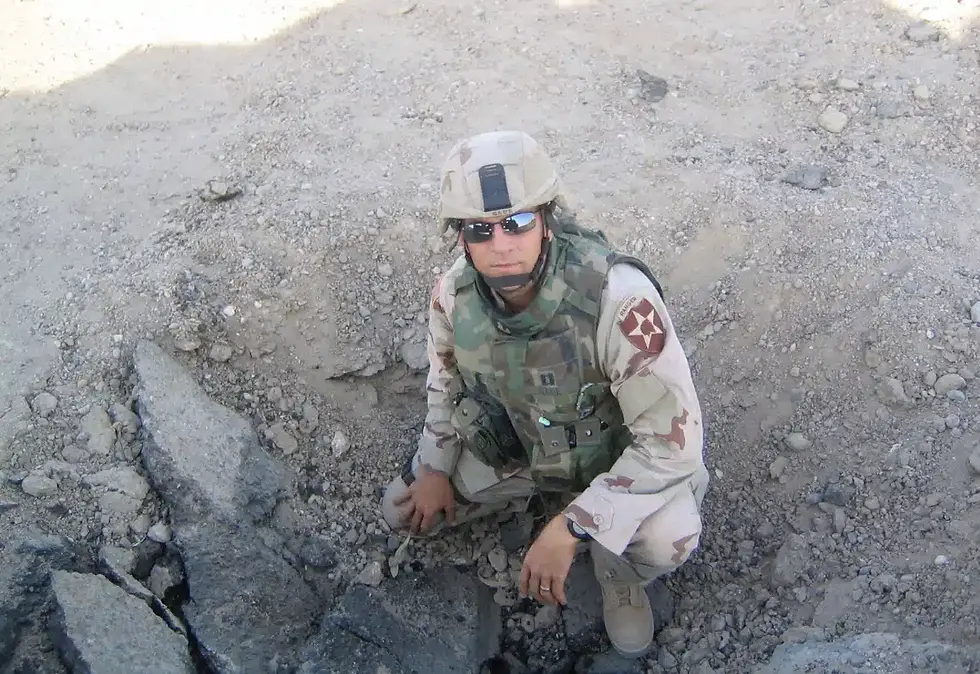
JP Lane was a U.S. Army Combat Engineer who deployed to Afghanistan in 2010, was blown apart by a 200-pound IED on July 2, 2011, and spent the next several years trying to end his life twelve times in a Fisher House room in San Antonio. Crystal Lane was a woman from five hours south who came to the city for a week, got cut from a dance team audition, and was about to go home when her cousin said don’t leave yet. What happened after that, the gym, the prayer, the two weeks, the six months, the marriage, the calling, is a story about how far a person can fall and still be caught. JP and Crystal Lane speak nationally to wounded veterans and their caregivers. They are based in San Antonio, Texas.
The Boy Who Made a Promise
The teacher had been called out of the room. When she rolled a box TV back in on wheels, every kid thought it was movie day.
It was September 11, 2001. JP Lane was in eighth grade language arts class in Wisconsin, and what came on the screen was not a movie. He watched the Twin Towers fall. He sat in tears with the rest of his class. And then, when the tears settled, something happened in him that he would not be able to fully explain for years. He made himself a promise, and he kept it to himself all the way through high school until Anthony called him up after graduation and said he wanted to join the Army and asked if JP wanted to come.
JP flew home. Anthony changed his mind in less than 24 hours, and knocked on JP’s door the morning after landing to say he was going to college instead. Anthony eventually became a police officer. JP’s youngest brother, Jacob, became a Marine.
“Nah, changed my mind. I’m gonna go to college.”
So JP went alone. When the recruiter asked what he wanted, he asked for the most dangerous job in the military. They told him that at this point in the war, searching for IEDs and clearing the threat at the very front of every mission was it. He said sign him up. His father didn’t speak to him for a week when he found out. It probably didn’t help that JP also told him he’d signed up for the most dangerous job in the military.
“He’s like, nah, changed my mind. I’m gonna go to college,” JP says.
He wanted to be the wall. The one at the front who stopped the enemy from reaching whoever came behind. He deployed to Afghanistan in 2010. When the back of the transport plane opened and the ramp came down, a sandstorm punched him in the face. He looked around at the desert and understood, in the way you only understand something when it is already happening to you, that the promise made in a Wisconsin classroom had just become real.
July 2, 2011
He was blown up on three separate missions during his deployment. The first two felt like roller coasters. He has always loved roller coasters.
“First of its kind to be penetrated by an IED.”
They were on the last route of the day. They had already cleared it once that morning, and in the morning the truck in front of JP’s had been blown up, a new crew had come in, and by the time they ran the route again in the afternoon they were almost done. The thinking was that it should be fine. The civilians had put the dirt back in the hole. It was a popular road. They were almost home. The Taliban had used the hole to plant a bigger IED.
The blast went straight through the floor of the truck. JP was in the driver’s seat. The vehicle flew up into the air and slammed down on the passenger side. Both legs were amputated. His left femur snapped in half. His pelvis snapped in half. His spine dislocated from his pelvis. His right arm snapped in half at 90 degrees. His right middle finger was amputated. His front teeth were knocked out when his face hit the steering wheel. His skull fractured against the four-inch bulletproof windshield, causing a traumatic brain injury. Everything inside his torso was destroyed except his heart and his left lung. His soldiers found his right foot and boot melted to the floorboard.
“My RG-31 was the first one of its kind to be penetrated by an IED,” he says. “If my right foot wasn’t amputated, I would have been melted to the floorboard of my truck, and I would have bled out and died.”
He was in a coma for six weeks. He died twice on the operating table. Twenty-eight surgeries, most of them while unconscious. He describes the coma as a complete blackout, the best nap of his life. When he came back out of it, he could barely press the tube at his tracheotomy hard enough to make a sound. He moved the sheet. He saw what was there. He looked at his father, who was sitting beside the bed.
“Well,” he said. “This is different.”
The bravest thing he would ever do was not the day he signed up for the most dangerous job in the military. It was not the day he deployed. It was not the morning he cleared a route that had already blown up the truck ahead of him. The bravest thing JP Lane ever did was keep waking up in that hospital room when every reason he had to stay was being stripped away, one by one, and the reason that was coming hadn’t arrived yet.

What the Blast Left
Before Afghanistan, JP Lane had a particular kind of mind. Things stuck on the first read. He retained everything. He was, by his own admission, a know-it-all, and he made sure everyone knew it. He memorized things the first time he saw them. He walked into rooms already certain he was the smartest person there. It wasn’t meanness. It was just how his mind had always worked, and he had never been given a reason to question it.
“The Lord allowed my brain to be whacked around.”
The skull fracture changed that. He doesn’t use clinical language for what the traumatic brain injury took. He found his own frame for it, and the frame is gratitude, which is either the most honest response a person can have to loss or the bravest, and in JP Lane’s case it is probably both.
“Knowing that the Lord allowed my brain to be whacked around for a second, to take that away from me, actually humbled me very quickly,” he says. “Things don’t stick, and I’m not smarter than anybody.”
There is one surgery from outside the coma that has never left him. They had to reopen his arm to refix the screws and plates holding the bones together. The painkillers were legally maxed before they put him under, and when he came out the other side none of it had touched the pain. He screamed until he passed out. Day after day. His mother sat in the room and sometimes could not watch and would step outside and come back when he was asleep.
He was maybe a little over 100 pounds at that point, fighting to hold on to a body that kept trying to let go.
“I saw a monster.”
His ex-wife at the time of his service was there during some of it. Then she wasn’t. She couldn’t handle what the situation had become. She left. The divorce went through while JP was still in recovery. He watched other warriors in physical therapy surrounded by their families, their children, their people cheering them on from the chairs along the wall. His own family had to go home. He was doing most of this alone, in the specific way that is worse than being alone at home because at least at home there is no one to watch while they are held.
He went to therapy. He came back to his room. He looked in the mirror. He could not yet see what was coming. He could only see what the mirror showed him, and the mirror was not kind, and the voice in his own head that agreed with it was relentless.
“Every time I looked in the mirror, I saw a monster and someone that was not gonna ever be loved,” he says. “And then all of a sudden the divorce happens. And it’s like, see?”
The Room
He was an adult. He could purchase a knife. He could purchase a gun. He could accumulate painkillers in a bottle. He laid them out on the table and sat with them and thought about which one he was going to use. He tried twelve times.
Each time, the same thing stopped him. Not a person. Not a program. A voice, saying the same word.
“I always heard the Lord say, nope.”
Every time. Nope. Wait. There is a purpose behind all of this. He didn’t always believe it. He tried again. The voice came back. Twelve attempts, twelve times the same answer, and each time he had to decide whether that answer was enough to keep going another day.
“Every time I attempted to either put the gun up to my head, or put the knife to my heart, or put the pills in my hands with a glass of water, I always heard the Lord say, nope,” he says.
He had been pushing everyone away. Telling them they couldn’t understand what he was going through. That they had all their limbs and he didn’t. That they had no business pretending to help. He was not entirely wrong. They didn’t understand, not really, not from the inside. But he had confused understanding with presence, and in doing so had turned the only thing that might have helped him into another reason to stay alone.
“They love me enough to still be there for me.”
Then, somewhere around the tenth or twelfth attempt, the question arrived differently. Do you go to a war zone with just one soldier? He said no. Then why are you doing this mentally by yourself? He sat with that. The combat engineer who had volunteered to be the wall, the man at the front who protected whoever came behind him, had been trying to fight his way through the hardest terrain of his life without a single person beside him. The question wasn’t gentle. It was tactical. And it landed the way tactical things land on people who have been trained to hear them.
“I humbled myself and allowed myself to be, like, even though they may not understand, they love me enough to still be there for me,” he says. “And I love them enough to be there for them.”
He came out of that room carrying something that cannot be trained into a person and cannot be taken by a blast. He had gone all the way to the bottom and found that the bottom held. Whatever he would build from that point forward would be built on ground that had already been tested by everything.

A Gym in San Antonio, 2017
Crystal had come to San Antonio for one week. She had auditioned for the Spurs dance team, made it all the way to the final cut, and was eliminated right before finals. She had prepared for this. She had wanted it. She packed her bags.
Her cousin, who lived in San Antonio, said don’t leave yet. Stay the weekend. Come to the gym with me first. Work off the stress before you drive home. Crystal was a gym rat. She said sure, why not.
They were in the back near the treadmills when her cousin spotted him from across the gym. People were calling his name from everywhere, people who knew him, people who wanted to say hello, the kind of attention that follows someone who has made himself impossible to look away from. Crystal looked over. She saw his upper body. She saw how everyone in the room seemed to know him.
“I said, not that guy. Because everybody knew him.”
Her instinct was to stay in her lane. Popular men in gyms are their own category of complication, and she had not driven to San Antonio to audition for that. Then he walked over. He told her she was working the cable pulldown machine better than half the men in the gym. He got Crystal’s name. He asked if she’d be there tomorrow.
“I said, not that guy. Because everybody knew him,” she recalls.
She said yes. She didn’t live there, hadn’t planned to stay another day, but she said yes, and she meant it enough to show up. It wasn’t until he walked away that she saw the prosthetics. She had seen his upper body and his confidence and the way everyone in the gym called his name. She had not seen that he had no legs. And when he walked away and she saw how he moved through the world on prosthetics, with no wheelchair, not asking for anything, just there, competing against himself the way he had always competed, something shifted in her that she would spend the next eight years learning the full shape of.
“He’s killing it,” she thought. “He’s at the gym with no legs.”
“I prayed that she has curly hair.”
JP had been praying specifically. A pastor had told him to pray with specifics, and so he had: a woman with curly hair, someone he could meet at a gym, because he didn’t want to have to convince a woman to share his life before she had chosen to share his habits. He asked that she have a strong relationship with God. He had been carrying this prayer for a while. He had been patient with it the way soldiers are patient with things they cannot control.
“I prayed that she has curly hair because I dig that. I want to meet her at the gym, ’cause I don’t want to force her to work out with me,” he says.
Crystal has curly hair, and she was at the gym. She showed up the next day at the time he told her he’d be there. On their first date, dinner, she mentioned she didn’t actually live in San Antonio. She lived five hours south.
“I was like, well, that has to change.”
He said it before he’d fully decided to say it. She didn’t flinch. They decided together that if it was meant to happen it would be easy. Crystal asked her boss at the bank about a transfer to San Antonio. The last available position in her job classification was open. Two weeks after meeting him, she moved.
Before she arrived, JP decorated her room with her favorite color, new sheets, new pillows, a new comforter. He made it beautiful so she would walk in and know that someone had already been thinking about her before she got there. Six months later, they were married at a courthouse in Brownsville. On their second anniversary they went to Hidden Falls in Spring Branch, Texas.
He had prayed for her specifically, down to the curly hair and the gym. She had almost gone home the weekend they met. Fate doesn’t announce itself. It shows up at the cable pulldown machine and asks if you’ll be there tomorrow.

What Crystal Chose
Nobody handed Crystal Lane a job description. There was no orientation, no transition period, no manual for what she was walking into. She moved to San Antonio two weeks after meeting a man whose body had been rebuilt from a 200-pound IED blast, who had tried to end his life twelve times, whose brain still didn’t hold things the way it used to, who carried a war inside him that no civilian relationship has a framework for. She knew some of this going in. She didn’t know all of it. She went all in anyway.
“I didn’t allow his disability to define who he is.”
The word caregiver doesn’t hold all of what she does. What it misses is the ordinary Tuesday. The dark day where she is not consulting a manual or following a protocol, just present, in the room, doing the real version of the work that doesn’t have a name because the people who do it are too busy doing it to stop and name it.
“I felt like God chose me,” she says. “I didn’t allow his disability to define who he is. I just knew it was about the heart.”
What she also chose, and keeps choosing, is to stand between JP and the thing that tries to use his history against him. She has watched it try. She knows what it looks like when it arrives and what it takes to name it and send it back.
In 2018, shortly after they married, they were in a car accident. Their vehicle rolled three times. JP was physically unhurt, but that night the nightmares came back hard, because the crash carried the exact smells of July 2, 2011. Smoke. Metal. The specific combination his nervous system had filed and never released. He didn’t know it at the time of the accident. He found out that night, in the dark.
The timing was not coincidental, at least not in JP’s telling. He had just returned from Operation Proper Exit, a program that brought wounded warriors back to the Afghan bases where they were injured, to stand in the place where it happened and tell their story to active-duty troops. JP had gone back to Afghanistan. He had stood in the place where the IED took him and let some of it go, put it back where it belonged. He came home on cloud nine. The accident happened three days later.
“The devil was like, no, I don’t like that. We’re gonna smash that to pieces right now.”
He recognized what was happening within two or three days. He named it out loud. He told it that it didn’t have control over him. He got back on the mission. Crystal watched this, the way she watches everything, not from behind him but beside him.
“The enemy wants to break this apart,” she says. “We have to have the full armor of God and keep this strong together. It’s about fighting for each other, not with each other.”
There is a peace in this marriage that is not the absence of hard things. It is the presence of two people who have each decided, separately and together, that the hard things will not be the reason they let go.

What He Built from the Wreckage
JP Lane competed in 11 events at the Warrior Games last year. He plays wheelchair basketball for the San Antonio Spurs NWBA team. He has won gold medals. He trains like someone who was told his fighting days were over and found that information unpersuasive.
“It means not yet.”
Ask what those gold medals mean to a soldier who was told his fighting days are over.
“It means not yet,” he says. “Adaptive sports encourages the warrior to not sit on the couch, to not dwell in it, to get out and fight for life, fight for something bigger than yourself.”
What adaptive sports gave back was not just competition. It was camaraderie, the thing military separation takes without asking. When you leave the service the battle buddies disperse. The team dissolves. Getting back on a court meant being on a team again, with people who showed up and competed and held each other accountable the way soldiers do. Everything had to be relearned from a seated position. The dribble. The shot. The chair itself. None of that was a problem for a man who had relearned everything from the ground up.
He is also a National Ambassador for Helping a Hero, which builds custom adaptive homes for combat-wounded veterans across the country. The day before this interview, he and Crystal had been at a welcome home ceremony in Alice, Texas, for a double amputee Marine named Justin. JP stands for Justin Patrick. Same first name. Same amputation. Above the knee, below the knee. JP stood at the ceremony that had once been his own, on the other side of it now, watching a family walk into a home that had been built around their specific wounds.
“Every warrior’s home has to be different because their injuries are different,” he says. “It is just an emotional wreck.”
He wrote a book. He is recording a Christian music album, a decision he wrestled with for years. He thought clean secular music was enough. Crystal kept praying. Last year he started recording songs for the Lord.
“Keeping secular music clean doesn’t inspire anybody,” he says. “It might inspire them to see me on the stage because they’re not used to seeing a double amputee up there living life to the fullest, but my priority should be lifting people up to God.”
Ask what success looks like for JP’s Journey five years from now.
“I hope they barely remember my name, but they realize that the testimony God gave me was the thing that encouraged them that no matter what they go through, they need to keep their eyes on Jesus.”
Ask if, knowing everything it cost him, he would make the same decision again. He doesn’t hesitate.
“I would get blown up and lose my legs a million times,” he says, “knowing I not only got to be a small part of saving lives, but now knowing how it saved me from a life and eternity in a downward spiral and destruction. I would make the sacrifice a million times in order for others not to have to endure the same pain and suffering I went through.”
His father, the Air Force man who didn’t speak to him for a week after he signed up for the most dangerous job in the military and who was sitting beside the hospital bed the morning JP moved the sheet and said, well, this is different, is still in the picture, closer than before in ways neither of them could have predicted.
“My relationship with my father since being blown up has gotten closer on so many levels,” he says, “and he continues to support my music career, and the mission I have been given for this life. I am grateful for my parents who continue to encourage me to stay strong in my faith and lift up those around me to do the same.”
For the One Still in That Room
There is a veteran sitting alone tonight. The lights are off. And somewhere close by is the person who loves them, who doesn’t know what to say.
JP Lane has been in that room. He knows what it looks like from inside it. He knows that the gun and the knife and the pills on the table feel like the only things that belong there. He knows what the mirror says. He knows the specific weight of watching everyone else be held while you are not.
He also knows what comes after. Not because it gets easy. Because it gets different.
“I love them enough to be there for them.”
Crystal knows the other side of the room. She knows what it is to be the person without the words who shows up anyway. To choose, day after day, to stay.
“Even though they may not understand, they love me enough to still be there for me,” JP says. “And I love them enough to be there for them.”
She almost didn’t stay in San Antonio that weekend. Her bags were packed. Her cousin said don’t leave yet. She stayed, and everything that followed began with that decision.
Everything JP Lane has built since the Fisher House room, every home he has walked wounded veterans into, every stage he has stood on, every song he is recording, every time he rolls onto the court, every morning he wakes up next to a woman with curly hair who prayed her way to him from five hours south, all of it began with one person saying to another: don’t leave yet.
Don’t leave yet.
Resources
JP’s Journey | jpsjourney.com
JP and Crystal Lane’s organization, offering speaking engagements, their book, and resources for wounded veterans and their caregivers.
Helping a Hero | helpingahero.org
National nonprofit building custom adaptive homes for combat-wounded veterans; JP Lane serves as National Ambassador.
Fisher House Foundation | fisherhouse.org
Provides free lodging near military and VA medical centers for families of wounded service members during treatment and recovery.
Warrior Games | dod.defense.gov/warriors
Department of Defense adaptive sports competition for wounded, ill, and injured service members and veterans.
Veterans Crisis Line | Dial 988, then press 1 | veteranscrisisline.net
Free, confidential crisis support for veterans, service members, and their families, available 24/7.
National Alliance on Mental Illness | nami.org/support-education/veterans-service-members
Resources for veterans navigating post-deployment mental health, including programs for service members and their families.
About JP and Crystal Lane
JP Lane is a U.S. Army Combat Engineer who deployed to Afghanistan in 2010 and was critically wounded by a 200-pound IED on July 2, 2011, sustaining a double amputation, traumatic brain injury, and 26 additional injuries requiring 28 surgeries. A Purple Heart recipient, he is a Warrior Games gold medalist, Under Armour Freedom Athlete, National Ambassador for Helping a Hero, founder of JP’s Journey, and a wheelchair basketball player for the San Antonio Spurs NWBA team. Crystal Lane is Executive Director of JP’s Journey and has served as JP’s caregiver since they married in 2017. Together they speak, write, and advocate nationally for wounded veterans and military caregivers. They are based in San Antonio, Texas.


Comments